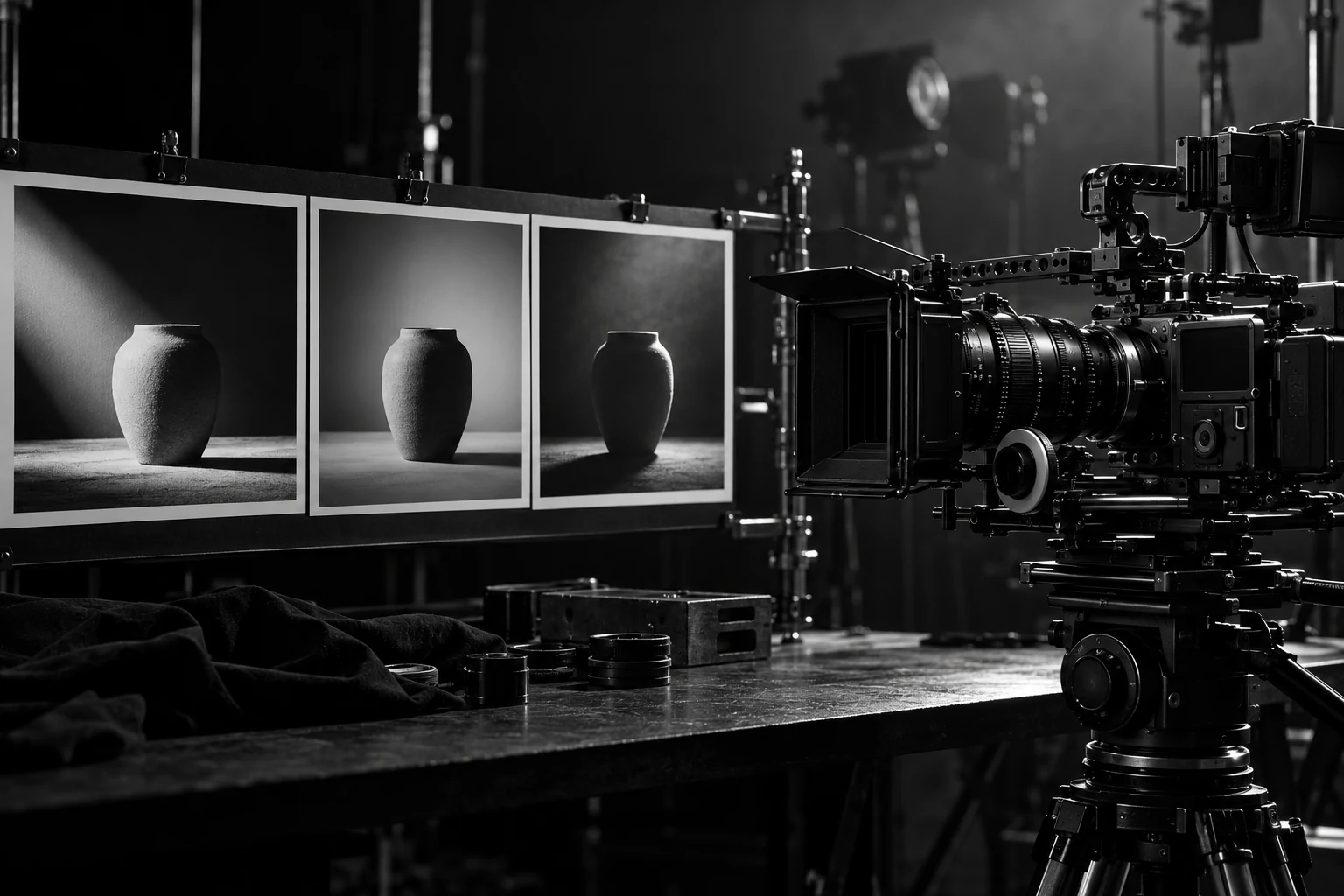
Tell the model what must happen in the shot and what must stay the same.
Say what happens
“Cinematic, premium, stunning, ultra-realistic” describes a hoped-for impression. It does not tell a video model what happens in the shot. If the result is wrong, those words also give you little help deciding what to change.
A useful brief starts with a subject and an action. A steel bottle stays upright on a black table. The camera moves slowly to the right. A narrow reflection travels across the surface. The cap, label, and proportions remain unchanged. That is a scene you can inspect.
Style still matters, but it should support the shot. Add lighting, material, and mood after the action is clear. If you cannot describe the important event in one or two sentences, the shot may need to be simplified before it needs a longer prompt.
Use five parts
First, name the subject and the details that define it. Second, describe the action. Third, explain the camera behavior. Fourth, describe the setting and light. Fifth, state the constraints that would make a result unusable.
Keep constraints connected to the job. “Preserve the cap geometry” is useful for a product shot. A long list of unrelated negative instructions can make the brief harder to maintain without solving the actual failure. Start with the few conditions you will really check.
Add duration, aspect ratio, and audio requirements when the chosen tool supports them. Verify the exact controls in that tool. A reusable production brief can stay the same even when the syntax or available options change between providers.
A product shot you can adapt
The following is an original example brief for an unbranded sample product. Replace the details with approved material before using it for a real campaign.
Purpose: show the bottle's shape clearly in a short product sequence.
Subject: the steel bottle in the supplied reference, upright on a matte black table.
Action: the bottle stays still throughout the shot.
Camera: one slow lateral move from left to right; no cuts and no orbit.
Light: a soft white strip reflection moves naturally across the metal.
Framing: leave room below the product for captions added later.
Keep fixed: cap shape, proportions, seams, and surface finish.
Audio: no dialogue or music; sound will be added in the edit.
Review: reject any take where the bottle bends or a detail changes.
This brief deliberately avoids a moving product and a moving camera at the same time. That makes the first test easier to review. Once the shot works, change one production requirement rather than replacing the whole brief with a more dramatic paragraph.
A human action needs a clear sequence
For an action shot, describe the order of events and what is visible. “A person places the closed notebook on the desk, releases it, and moves their hand away” creates a different sequence from “a person reaches for a notebook.” If contact with an object matters, say so.
Keep the movement modest in the first test. Check hands, contact points, occlusion, and the final position. A plausible action at normal speed may still contain a moment that breaks the demonstration. The more important the physical claim, the more carefully it needs to be checked against real behavior.
If the shot must preserve a particular person’s identity, use approved references and the appropriate permissions. If it represents a fictional character, record that too. The production brief should make it clear what is being portrayed rather than leaving the editor to guess later.
Diagnose the failure before rewriting
When a take fails, name the failure precisely. Did the object change shape? Did the camera move in the wrong direction? Did the action happen too early? Did the scene become too busy for the product to read?
Then change the part of the brief that could explain it. Simplify the motion, clarify the reference, reduce the number of actions, or choose a different production method. Adding more synonyms for realism rarely tells you which change helped.
Keep a short version log. For each change, record the reason and whether it improved the relevant detail. You do not need a laboratory notebook for every clip, but a few useful notes prevent the team from repeating the same unsuccessful experiment next week.
Hand over more than the final clip
Deliver the accepted clip with the brief, references, version, and a note about any remaining limitations. Include the editable project or source material where the workflow supports it. That makes a later crop, translation, or offer change much easier to manage.
The editor should know which details are reliable and which parts need careful handling. If a take works only before a certain frame, say so. If a product label was composited, preserve the approved artwork and the edit.
A strong video brief is a small agreement about what the shot must do. It makes generation easier to direct, review more specific, and production easier to repeat. Length is useful only when it adds information the shot actually needs.
About this article
Prepared by JDGMNT Editorial on 24 October 2026. Worked examples are illustrative; they are not campaign results or product benchmarks. The artwork was generated for this collection.