
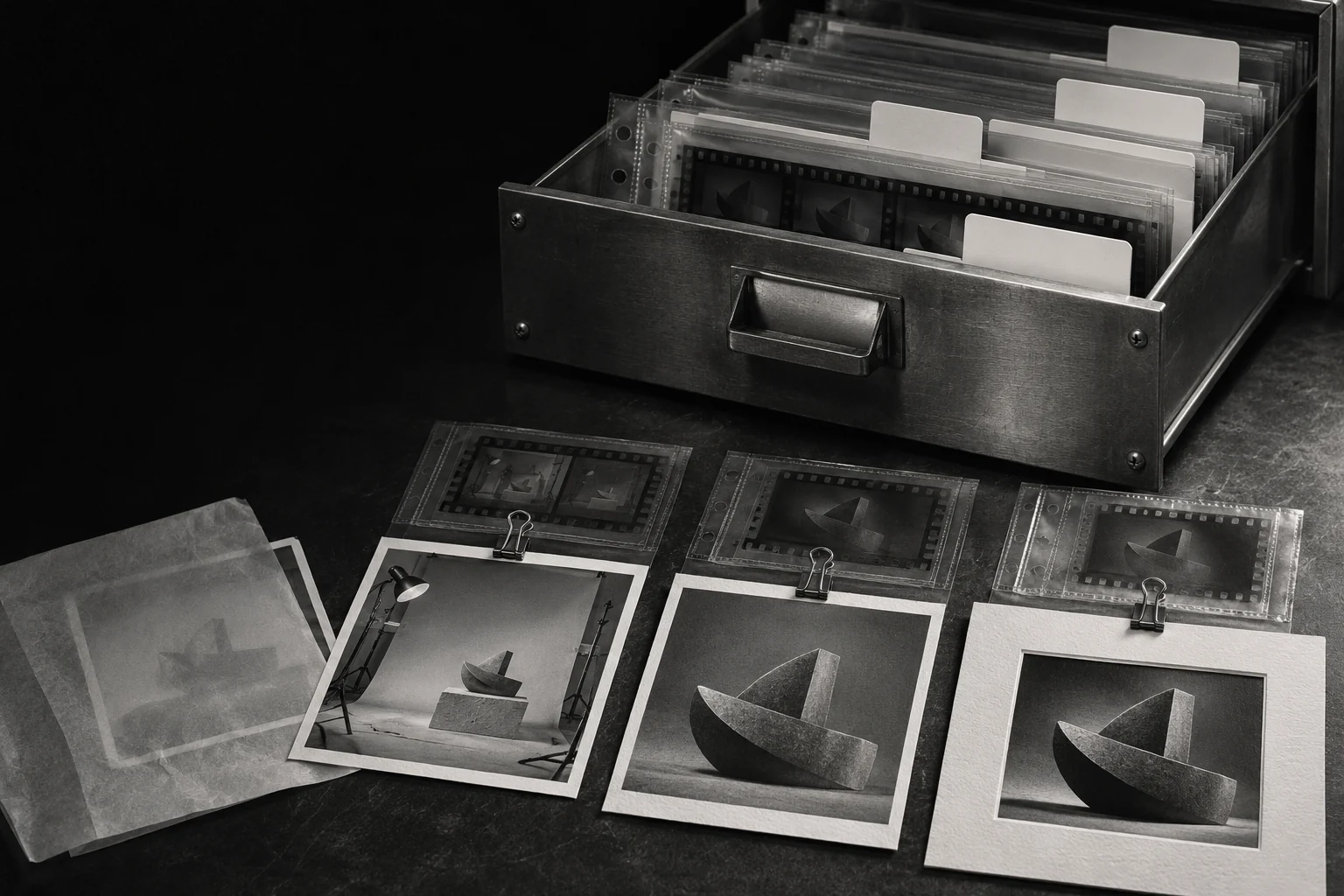
Record what each asset depends on. A precise history makes corrections smaller, handoffs clearer, and withdrawn versions easier to find.
The wrong version can look completely finished
The image is sharp. The crop fits. The caption has been approved. Then someone notices the character is based on last month’s reference, the product label belongs to an old package, or the supposedly final video contains a soundtrack nobody cleared for this campaign.
These failures do not necessarily come from poor creative judgment. They come from losing the relationships between files. A folder can tell you what exists without telling you what each item depends on, what changed, or which approval still applies.
Generative production makes that problem easier to create. One reference produces ten images. Three become video inputs. Two videos are edited into several formats. Someone replaces a file under the same name, and the next batch starts from a different reference without anyone explicitly making that decision.
The useful unit is therefore not just the asset. It is the asset plus its history: source inputs, transformations, approvals, and destinations. You do not need an enterprise platform to start keeping that history. You do need to stop expecting “final_final_v7” to carry the whole story.
Record relationships, not just filenames
Give each source, reference, generation, edit, and export a stable identifier. Record which parent assets it used. A generated portrait might depend on reference R3 and prompt P12. A short video might depend on that portrait, source clip S8, and model job J42. A square export might depend on the approved edit E6.
That creates a simple dependency graph: a map of what came from what. It is more useful than a chronological list when you discover a defect, because not every newer file necessarily depends on the defective one.
Keep the file’s content hash as well as its friendly name. A cryptographic hash can help detect whether the bytes changed. It does not prove that the picture is truthful, that the person is the intended character, or that the content is suitable for publication. Those are separate review decisions.
An approval should point to a specific asset version and use. Approval of a portrait for a profile page does not automatically approve a later edit for a paid ad with a different claim. If the file or consequential context changes, the record should make that change visible rather than inheriting a comforting green checkmark.
For a small team, a structured manifest beside the files can be enough. The important fields are understandable without special software: identifier, parents, file hash, creation method, review status, reviewer, intended destination, and notes about limitations or restrictions.
Trace the affected branch before rebuilding everything
Imagine a fictional creator campaign with fifteen ready-to-publish assets. Five descend from identity reference R2. The other ten descend from the approved R3 reference. A review discovers that R2 has an inconsistent facial feature.
Without dependency records, the team has two unpleasant options: inspect every file from scratch or replace the entire campaign. With records, it can immediately flag the five known descendants for review and hold their scheduled publication. The other ten are not automatically defective merely because they share a folder.
That does not mean the ten are guaranteed safe. A person may have used R2 manually without recording it, or the defect may exist in another branch. The graph narrows the first investigation; it does not replace visual inspection or good recordkeeping.
Once the five affected assets are corrected, their new identifiers should point to R3 and the new generation or edit. Do not overwrite the old outputs and pretend the earlier version never existed. Retaining the superseded versions makes it possible to explain what was replaced and to identify any old copies still circulating.
This is particularly valuable when the same content appears in a profile, a social wall, an ad account, and a partner’s folder. A destination record lets the team ask a concrete question: which places received the withdrawn version? A folder called “approved” cannot answer it.
Hold and inspect this branch.
Review status does not change automatically.
A dependency map narrows the investigation. It does not guarantee that every manual input was recorded or every unaffected asset is correct.
Provenance is useful without being a truth machine
C2PA provides a standard for recording signed provenance information associated with media. Its materials describe a way to make parts of an asset’s history inspectable and tamper-evident. That can complement an internal asset record, especially when supported tools preserve the relevant information. [1]
It is not a substitute for judging the content. C2PA’s harms documentation explicitly distinguishes a valid manifest from proof that the depicted content is true. An asset without credentials is not automatically false either. [2]
This distinction matters for synthetic creators. A provenance record might accurately describe that an image was generated and edited. It does not establish that the character’s claimed experience happened, that a product endorsement is appropriate, or that the image matches the intended identity. Those questions still require editorial decisions.
Similarly, do not treat a credential badge as a complete permissions record. Keep the material needed to understand the intended commercial use in your own production records, and resolve uncertainties before publishing. A provenance tool can carry information; it cannot make an unsupported permission assumption become true.
The practical goal is a shorter, more reliable investigation when something is questioned. Which source did we use? What transformation happened? What was reviewed? Which version left the studio? A system that answers those questions honestly is valuable even when it does not settle every dispute about the content.
Keep the private production record separate from the public asset
The internal manifest may contain prompts, source locations, reviewer notes, contracts, contact details, or unpublished campaign plans. Not all of that belongs in a downloadable image or public metadata field. Decide what the production team needs to retain and what the audience needs to see.
For a public synthetic-creator profile, a clear disclosure that the character and content are AI-generated may be more useful than exposing an internal job identifier. For an editorial illustration, an accurate artwork label can distinguish the image from documentary evidence. The public description should explain what a viewer is looking at.
Internally, retain enough information to reproduce the process as far as the tools permit. Record the model route and version when available, the actual input references, important settings, and the output returned by the service. A saved prompt alone is not a complete production recipe.
Do not promise exact reproduction merely because a seed was recorded. Provider implementations and model versions can change, and some systems do not offer deterministic reproduction. The record’s first job is traceability: explaining how this approved artifact came to exist. Reproducibility is an additional capability to test, not assume.
Back up the records with the assets. A perfect manifest pointing to an expired download link is a beautifully organized dead end.
Make the handoff smaller and more precise
For the next campaign, try a simple release package. Include the approved exports, a contact sheet, the current reference record, a manifest of dependencies, and a short destination list. Mark superseded material clearly. Keep experimental outputs outside the folder the publisher uses.
At handoff, check the actual files against the approved identifiers. Review the crop, visible details, caption, disclosure, and destination together. An image can be correctly approved and still become misleading when paired with a different caption or placed beside an unsupported claim.
Our creator library makes identity continuity visible across profile material and sample content. The same principle applies behind the scenes: a recognizable character needs a consistent source record, not merely a collection of images that look approximately related.
As the library grows, automate the mechanical checks. A script can detect missing parent identifiers, changed hashes, unpublished assets referenced by a release, or exports that depend on a withdrawn reference. People should spend their attention on the visual and editorial decisions that those checks cannot settle.
The benefit is not bureaucracy for its own sake. It is the ability to change one thing without losing control of fifteen others—and to answer “Which version did we publish?” without opening six folders and asking three people.
Sources & notes
Primary references for the product details and research discussed above. The examples and practical recommendations are our editorial interpretation.
- Coalition for Content Provenance and AuthenticityC2PA FAQ ↗
Official explanation of provenance, signed manifests, ingredients, and practical limitations. Checked November 11, 2026.
- Coalition for Content Provenance and AuthenticityC2PA Harms Modelling, version 2.0 ↗
Explicitly distinguishes valid provenance from proof that content is true, and cautions against treating missing credentials as proof of falsity.
CHECKED / 11 NOVEMBER 2026
About this article
Prepared by JDGMNT Editorial on 11 November 2026. The fifteen-asset dependency example and release package are proposed practices. C2PA credentials are not treated as proof of content truth, identity fidelity, or a complete permissions record. References are dated to the source check above. The artwork was generated for this collection.