
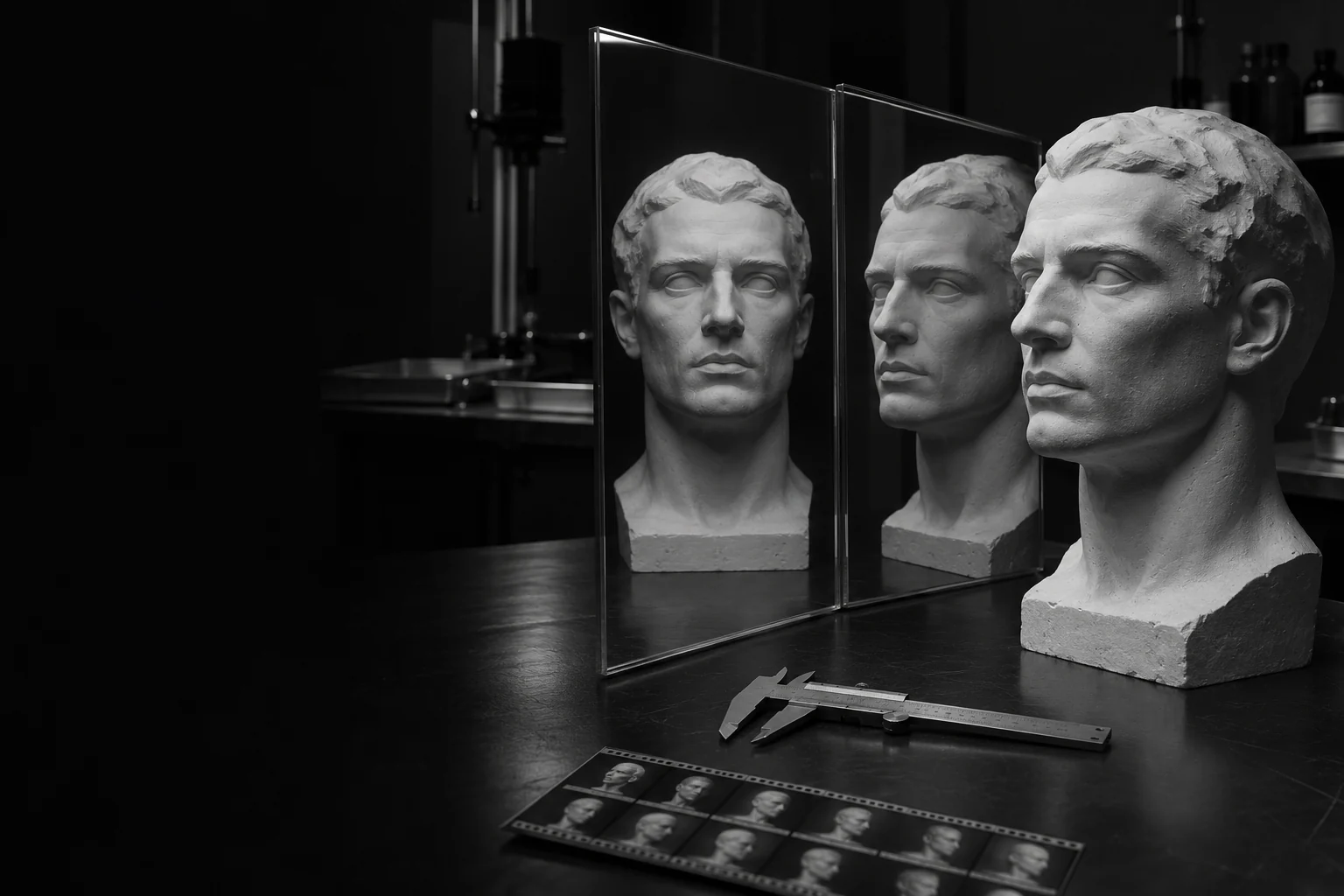
Review the whole delivered clip. A high average similarity score can conceal the few moments that make a character unusable.
A great opening frame can hide a bad video
The creator looks right in the thumbnail. The first turn is convincing. Then a sleeve passes over their face, the outfit changes, and someone else appears for half a second. The lighting is beautiful. The file is useless for the brief.
That failure gets missed when the review question is simply, “Does this look good?” A synthetic creator needs several things to remain true at once: a recognizable identity, believable motion, the intended action, and continuity with the surrounding content. An attractive frame proves only one small part of that.
VBench, a published video-generation evaluation framework, separates dimensions such as subject consistency, temporal flickering, and motion smoothness. That separation is useful: a clip can do well on one dimension while failing another. Its benchmark results are not a certification that a particular fictional creator stays consistent in your production. [1]
Our proposed review method treats identity as a condition the whole delivered clip must satisfy, rather than a quality score that can be averaged away. It is a production rubric, not a validated biometric identification system. The practical aim is modest: catch a wrong-looking character before a beautiful export becomes the approved version.
Define what is allowed to change
Start with a short identity record. Include a clear face reference, a three-quarter view, a full-body view, and a written description of the features that make the character recognizable. Use images that agree with one another. A folder of attractive but inconsistent references gives the model several different people to choose from.
Separate identity anchors from scene choices. Facial proportions, the characteristic brow shape, hairline, and a distinctive visible feature may be anchors. A jacket, hairstyle, makeup intensity, lighting direction, and expression can change when the brief calls for it. “Keep everything identical” is usually an impossible instruction once the person moves through a real scene.
This distinction also prevents a common reference mistake. A model sees a person in a beige top and interprets the top as part of the requested identity. The character stays recognizable, but the original outfit disappears. Your review therefore needs two independent questions: did the person remain the intended character, and did the model preserve the clothing and actions that the video was supposed to control?
Write those decisions before generating. For a clothing-change video, the source controls the sequence and wardrobe; the identity reference controls the person. For a fashion concept with no source video, the wardrobe may instead be part of the creative direction. The same reference image can play a different role in each job.
Inspect transitions rather than convenient timestamps
A frame every two seconds is easy to collect. It is also easy to fool. A brief identity change between samples will disappear from that contact sheet.
Build the review around events. Mark head turns, hands over the face, hair movement, leaving and re-entering the frame, lighting changes, camera cuts, and changes of clothing. Inspect just before, during, and immediately after each event. Add evenly spaced samples to cover the quieter parts, then watch the complete clip at normal speed.
The two views answer different questions. A paused frame helps compare geometry and details. Normal playback reveals whether a face appears to slide, reset, or change age in motion. A technically plausible frame can still produce a very strange transition when placed between its neighbors.
Use a simple record for every event: timestamp, intended identity, observed issue, severity, and an image or short excerpt. Record an uncertain judgment as uncertain. Do not turn a difficult angle into a confident failure just because it differs from a front-facing reference. A second reviewer should be able to see what the first reviewer meant without decoding “something feels off.”
For a repeatable test, hide the model name and attempt number from reviewers. Show the same identity references and the same brief each time. Reviewers should assess the artifact, not reward the version they know took longer to make.
A high average can conceal six failed clips
Consider an invented production test: 40 clips, each reviewed at 12 planned checkpoints, with a full playback review afterward. That creates 480 checkpoint observations. Suppose 18 checkpoints fail identity review and those failures occur in six different clips.
The checkpoint pass rate is 462 divided by 480, or 96.25%. That sounds close to finished. But if each clip must preserve the character throughout, only 34 of the 40 clips pass: 85% before considering any additional problems found during playback.
Neither percentage is a universal measure of quality. They answer different questions. The first describes the inspected moments. The second describes how many complete files are ready for the intended use. A producer paying for usable outputs generally needs the second number as well as the first.
Keep the failure distribution. Six clips with isolated problems suggest a different repair plan from 18 failures spread through one difficult scene. If every failure follows a hoodie being pulled over the head, you have a targeted test case. If failure occurs across unrelated scenes, your references, model choice, or definition of the character may need broader work.
Do not call 480 observations 480 independent tests. Checkpoints from the same clip share the same generation and are correlated. Treating them as independent evidence would make uncertainty look smaller than it is. Report the number of clips, their scene types, the sampling method, and how many passed as complete deliverables.
462 of 480 inspected moments
34 of 40 delivered clips
Six clips still need correction. Eighteen failed checkpoints can hide inside an impressive average.
Make the next attempt answer one question
When a generation drifts, the temptation is to change the prompt, reference, model, resolution, and source clip together. Sometimes that produces a better video. It rarely teaches you which change helped.
Keep a small diagnostic sequence. First confirm the file meets the selected endpoint's requirements. Then confirm the image is in the correct reference field. Next compare a clear identity reference against the existing reference while holding the rest of the job fixed. If the drift follows a particular event, use that event as the review target.
This does not mean splitting every production into dozens of shots. If the model accepts the complete source and the result works, keep that efficient workflow. Segment only when a real input limit or an editorial decision requires it. More segments create more boundaries at which the identity, lighting, and timing can disagree.
Set a review gate before approving a batch. For example: no identity resets visible during full-speed playback, no unexplained wardrobe substitution, and no severe anatomy errors in the intended crop. These are proposed acceptance criteria, not guarantees that a model will meet them. If an attempt fails, name the failure and save it. Avoid relabeling an almost-right result as final because the budget is uncomfortable.
Build a character record that survives the next shoot
The useful output of this process is more than a preferred image. It is a compact record of what the character looks like, which references have been approved, what kinds of motion have been tested, and where the workflow still struggles.
Store the approved reference version with each job. Keep the source video, prompt, settings, provider route, output, and review decision together. Two services may expose the same model through different input contracts. A successful run with one interface is not evidence that an untested interface accepts the same fields or dimensions.
For the next production, reuse the identity record and add one genuinely new challenge. A seated talking portrait does not establish consistency during a fast turn or an outfit change. Expand the tested range deliberately instead of treating a successful thumbnail as permission to promise anything.
Our creator library keeps character references alongside authored personalities and sample content. The production standard should be equally concrete: the person is recognizable, the scene follows the brief, and the whole file survives review. A convincing first frame is the start of that work.
Sources & notes
Primary references for the product details and research discussed above. The examples and practical recommendations are our editorial interpretation.
- Huang et al. / CVPR 2024VBench: Comprehensive Benchmark Suite for Video Generative Models ↗
First submitted November 2023; published at CVPR 2024. Separates video quality into dimensions including subject consistency, motion smoothness, and temporal flickering. It does not certify identity fidelity for a particular fictional creator.
CHECKED / 11 NOVEMBER 2026
About this article
Prepared by JDGMNT Editorial on 11 November 2026. The forty-clip review, checkpoint counts, and acceptance rubric are hypothetical. This is a proposed production review, not a biometric identification system or a report of JDGMNT benchmark results. References are dated to the source check above. The artwork was generated for this collection.